Motka
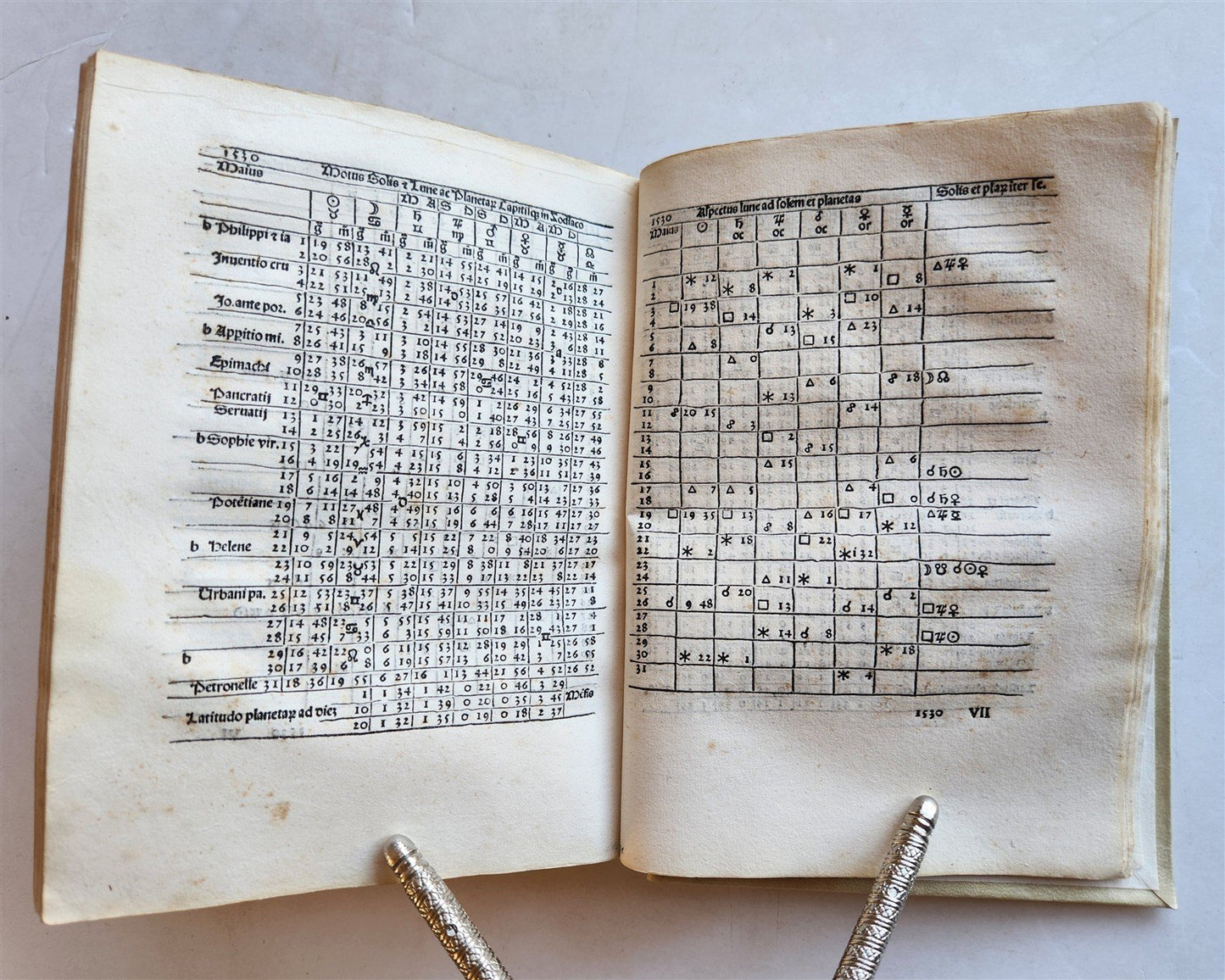
1521 Post-Incunabula ASTROLOGY & ASTRONOMY ALMANACH NOVA by J. Stoeffler ANTIQUE
1521 Post-Incunabula ASTROLOGY & ASTRONOMY ALMANACH NOVA by J. Stoeffler ANTIQUE
Regular price
$2,499.00 USD
Regular price
$3,570.00 USD
Sale price
$2,499.00 USD
Unit price
per
Couldn't load pickup availability
Johannes Stoeffler (1452-1531) & Jacob Pflaum
Almanach Nova
plurimis annis venturis iservientia
Venice: In aedibus Petri Liechtenstein, 1521
An almanac published in collaboration with the astronomer Jacob Pflaum of Ulm, which was designated as a continuation of the ephemeris of Regiomontanus.
It had a large circulation, underwent 13 editions until 1551 and exerted a strong effect on Renaissance astronomy.
Quarto, title page printed in red and black,
illustrated with woodcut tables and diagrams throughout with beautiful full-page woodcut printer's mark in red and black on verso of last leaf;
bound in nicely executed later vellum with manuscript title to the spine; contents mostly clean, with some foxing,
192 leaves
overall very good;
Not in British museum. RBH lists 4 copies sold between 1951 and 2006.
Ephemerides, by nature ephemeral, require constant recalculating and republishing.
So, although this is a later edition of the original almanacs Stoeffler & Pflaum began calculating and publishing at the end of the previous century, it's really more of an update, and not at all a reprint.
This edition for 1521 contains new work, as it covers astronomical data for the upcoming decade, with charts through 1531.
Size 6 1/4 by 8 3/4 in.
Text in Latin
Extremely rare, as are all editions of this highly important astrological almanach.
It is followed by the Ephemerides from 1521-1531, which are tables for stated times giving the apparent position and other numerical particulars relating to a heavenly body. They consist of 14 leaves for each year and a separate title.
The indispensability of these tables for the astronomer and navigator is well-known. They were in constant use for more than a century and literally read to pieces, hence their great rarity. The difficult setting of the tables and the multitude of astrological signs make this handsome quarto a typographical masterpiece.
A fine and complete copy.
Ex-libris:
Professor, Astronomer, Historian & Bibliophile Owen Gingerich, Smithsonian Astrophysical Observatory, Cambridge, MA
=======================
Johannes Stoffler (also Stofler, Stoffler, Stoeffler; 1452 –1531) was a German mathematician, astronomer, astrologer, priest, maker of astronomical instruments and professor at the University of Tubingen.
Stoffler was born on 10 December 1452 in Justingen (now part of Schelklingen) on the Swabian Alb.
Having received his basic education at the Blaubeuren monastery school, he registered at the newly founded University of Ingolstadt on 21 April 1472, where he was consequently promoted Baccalaureus in September 1473 and Magister in January 1476. After finishing his studies he obtained the parish of Justingen where he, besides his clerical obligations, concerned himself with astronomy, astrology and the making of astronomical instruments, clocks and celestial globes. He conducted a lively correspondence with leading humanists - for example, Johannes Reuchlin, for whom he made an equatorium and wrote horoscopes.
In 1499, Stoffler predicted that a deluge would cover the world on 20 February 1524.
In 1507, at the instigation of Duke Ulrich I, he received the newly established chair of mathematics and astronomy at the University of Tubingen, where he excelled in rich teaching and publication activities and finally was elected rector in 1522.
By the time of his appointment, he already enjoyed a virtual monopoly in ephemeris-making in collaboration with Jacob Pflaum, continuing the calculations of Regiomontanus through 1531, and then through 1551, the latter being published posthumously in 1531.
His treatise on the construction and the use of the astrolabe, entitled Elucidatio fabricae ususque astrolabii, was published in several editions and served astronomers and surveyors for a long time as a standard work.
Philipp Melanchthon and Sebastian Munster rank among his most famous students. Stoffler died of the plague in Blaubeuren on 16 February 1531 after an epidemic forced the division and relocation of his university to the surrounding countryside in 1530.
=========================
Thank You
Refund Policy: We will issue a FULL REFUND, 100% money back if you are not satisfied with your purchase. Items must be returned to us within 20 days in order to receive a refund or replacement. Buyer is responsible for shipping costs.