Motka
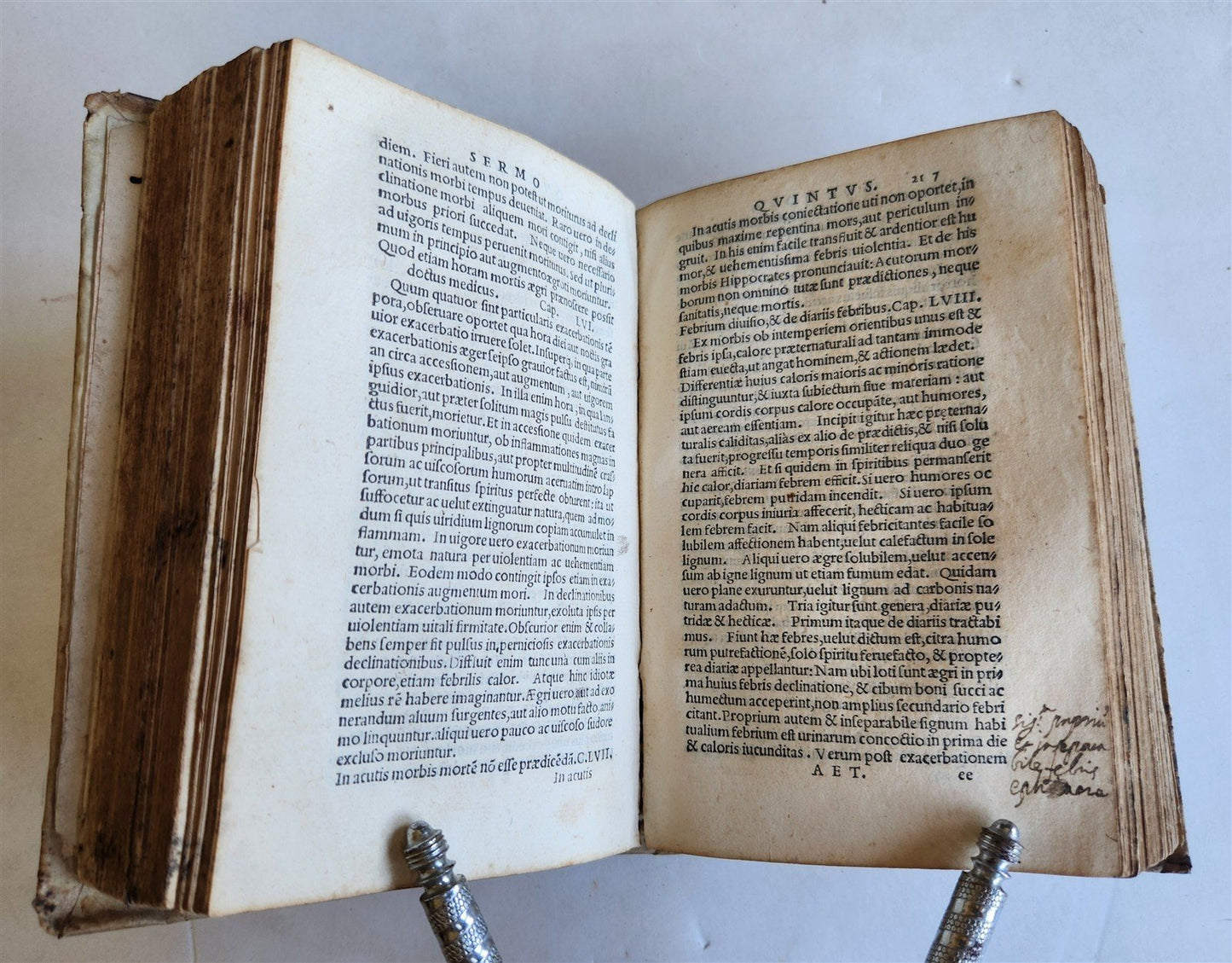
1543 MEDICAL TREATISE by Aetius Amidenus antique 16th CENTURY vellum bound
1543 MEDICAL TREATISE by Aetius Amidenus antique 16th CENTURY vellum bound
Regular price
$649.60 USD
Regular price
$928.00 USD
Sale price
$649.60 USD
Unit price
per
Couldn't load pickup availability
Aetius Amidenus
Contractae ex veteribus medicinae sermones XVI
Venetiis: ex officina Farrea; 1543
[8], 469, [3] pp.
Printer's device with salamander on the title page,
different device at the end, woodcut initials.
Period manuscript ownership note on the title page, front endpapers with ownership note and one annotated note on both recto and verso.
Fresh leaves with slightly yellowed margins and occasional faded foxing.
Small woodworm gallery on the lower external corner from B5 to C3,
occasional period marginalia. Broken inner front hinge
Original limp vellum binding with manuscript title on the spine
Size 4 by 6 3/4"
Text in Latin
==========================
Aëtius of Amida ( Latin: Aëtius Amidenus; fl. mid-5th century to mid-6th century) was a Byzantine Greek physician and medical writer,[
particularly distinguished by the extent of his erudition.
Aëtius was probably a Christian.
If so, he would be among the earliest recorded Greek Christian physicians.
Aëtius was born a Greek and a native of Amida (modern Diyarbakir, Turkey), a city of Mesopotamia, and studied at Alexandria, which was the most famous medical school of the age.
Aëtius mentions Patriarch Cyril of Alexandria, who died in 444, and Petrus archiater, probably the physician of Theodoric the Great, whom he defines as a contemporary, so it appears that he wrote at the very end of the 5th century or the beginning of the 6th. He is in turn quoted by Alexander of Tralles, who lived probably in the middle of the 6th century.
Aëtius traveled and visited the copper mines of Soli, Cyprus, Jericho, and the Dead Sea.
Aëtius seems to be the first Greek medical writer among the Christians who gives any specimen of the spells and charms so much in vogue with the Egyptians, such as that of Saint Blaise in removing a bone which sticks in the throat, and another in relation to a fistula.
The division of Aëtius' work Sixteen Books on Medicine into four tetrabibli was not made by himself, but (as Fabricius observes) was the invention of some modern translator, as his way of quoting his own work is according to the numerical series of the books. Although his work does not contain much original matter, and is heavily indebted to Galen and Oribasius, it is nevertheless one of the most valuable medical remains of antiquity, as being a very judicious compilation from the writings of many authors, many from the Alexandrian Library, whose works have long since been lost.
Aëtius is recorded as having developed a concoction for contraception consisting of aloe, wallflower seed, pepper, and saffron. He is also known to have developed an abortifacient mixture, whose contents are not known.
===============================
Please see my other auctions
Thank You
==========================
Aëtius of Amida ( Latin: Aëtius Amidenus; fl. mid-5th century to mid-6th century) was a Byzantine Greek physician and medical writer,[
particularly distinguished by the extent of his erudition.
Aëtius was probably a Christian.
If so, he would be among the earliest recorded Greek Christian physicians.
Aëtius was born a Greek and a native of Amida (modern Diyarbakir, Turkey), a city of Mesopotamia, and studied at Alexandria, which was the most famous medical school of the age.
Aëtius mentions Patriarch Cyril of Alexandria, who died in 444, and Petrus archiater, probably the physician of Theodoric the Great, whom he defines as a contemporary, so it appears that he wrote at the very end of the 5th century or the beginning of the 6th. He is in turn quoted by Alexander of Tralles, who lived probably in the middle of the 6th century.
Aëtius traveled and visited the copper mines of Soli, Cyprus, Jericho, and the Dead Sea.
Aëtius seems to be the first Greek medical writer among the Christians who gives any specimen of the spells and charms so much in vogue with the Egyptians, such as that of Saint Blaise in removing a bone which sticks in the throat, and another in relation to a fistula.
The division of Aëtius' work Sixteen Books on Medicine into four tetrabibli was not made by himself, but (as Fabricius observes) was the invention of some modern translator, as his way of quoting his own work is according to the numerical series of the books. Although his work does not contain much original matter, and is heavily indebted to Galen and Oribasius, it is nevertheless one of the most valuable medical remains of antiquity, as being a very judicious compilation from the writings of many authors, many from the Alexandrian Library, whose works have long since been lost.
Aëtius is recorded as having developed a concoction for contraception consisting of aloe, wallflower seed, pepper, and saffron. He is also known to have developed an abortifacient mixture, whose contents are not known.
===============================
Refund Policy: We will issue a FULL REFUND, 100% money back if you are not satisfied with your purchase. Items must be returned to us within 20 days in order to receive a refund or replacement. Buyer is responsible for shipping costs.