Motka
1550 ASTROLOGY Annotationi sopra la Lettione della Sphera del Sacrobosco ANTIQUE
1550 ASTROLOGY Annotationi sopra la Lettione della Sphera del Sacrobosco ANTIQUE
Regular price
$1,498.70 USD
Regular price
$2,141.00 USD
Sale price
$1,498.70 USD
Unit price
per
Couldn't load pickup availability
Mauro da Firenze (1493-1556)
Annotationi sopra la Lettione della Sphera del Sacrobosco.
Florence: Lorenzo Torrentino, 1550
First edition, octavo, large astrological square woodcut on title page;
illustrated with text woodcut diagrams;
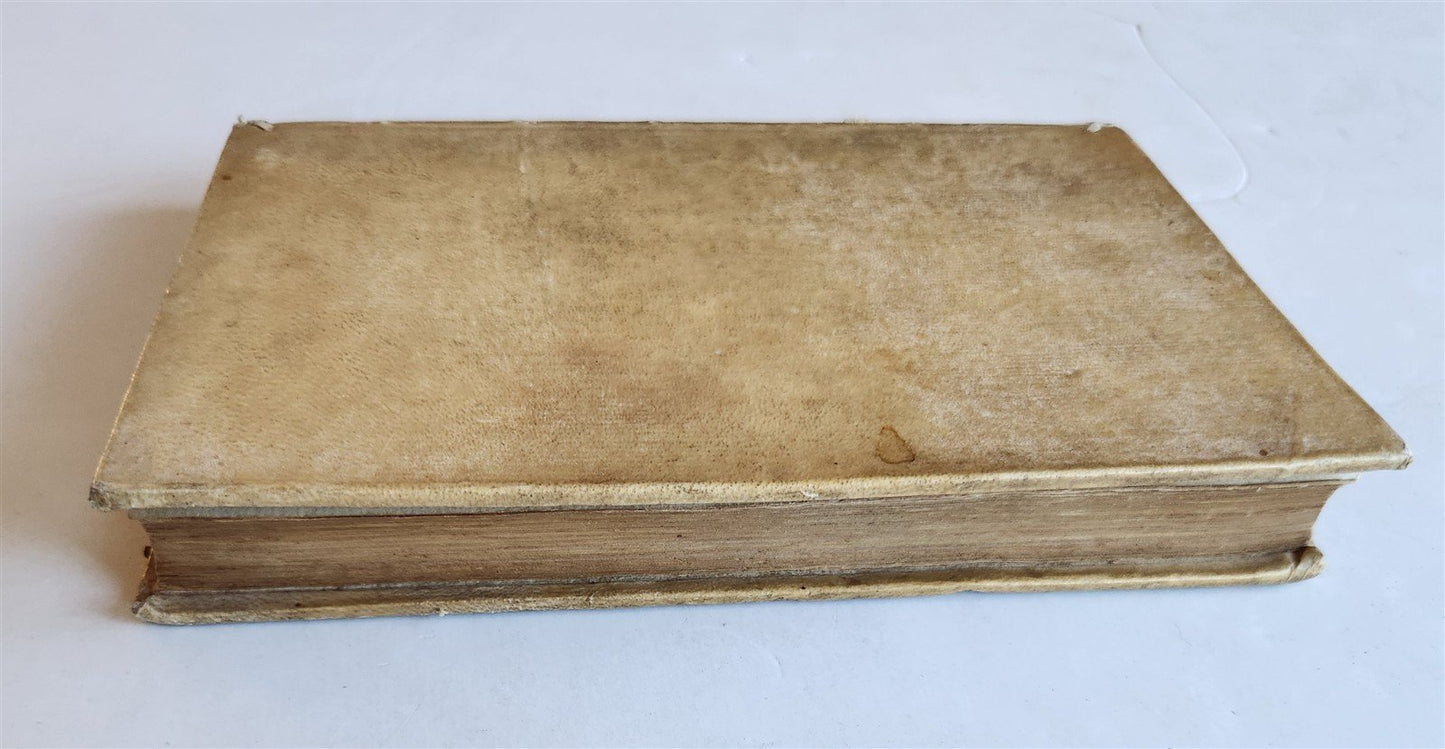
bound in full vellum over boards; two small wormholes in the last third of book patched with opaque paper
Size 5 1/4 by 8 in.
Text in Latin
Ex-libris:
Professor, Astronomer, Historian & Bibliophile Owen Gingerich, Smithsonian Astrophysical Observatory, Cambridge, MA
=======================
Christopher Clavius, SJ (1538 – 1612) was a Jesuit German mathematician and physicist, head of mathematicians at the Collegio Romano, and astronomer who was a member of the Vatican commission that accepted the proposed calendar invented by Aloysius Lilius, that is known as the Gregorian calendar.
Clavius would later write defences and an explanation of the reformed calendar, including an emphatic acknowledgement of Lilius' work.
In his last years, he was probably the most respected astronomer in Europe and his textbooks were used for astronomical education for over fifty years in and even out of Europe.
----------------
Clavius wrote a commentary on the most important astronomical textbook of the late Middle Ages, De Sphaera of Johannes de Sacrobosco. The commentary by Clavius was one of the most influential astronomy textbooks of its time and had at least 16 editions between 1570 and 1618, with Clavius himself revising the text seven times and in each case greatly expanding it.
In the 1585 edition of his aforementioned commentary he located (independently of Tycho Brahe) the nova from 1572 in the fixed stars sphere (in the constellation of Cassiopeia) and found that the position of the nova was exactly the same for all observers. That meant that it had to be beyond the Moon, and the doctrine that the heavens could not change was proven false.
As an astronomer Clavius adhered strictly to the geocentric model of the Solar System, in which all the heavens rotate about the Earth. Though he opposed the heliocentric model of Copernicus, he recognized problems with the Ptolemaic model. He was treated with great respect by Galileo, who visited him in 1611 and discussed the new observations being made with the telescope; Clavius had by that time accepted the new discoveries as genuine, though he retained doubts about the reality of the mountains on the Moon and said he could not see the four Jupiter's satellites through the telescope.
=========================
Thank You
Refund Policy: We will issue a FULL REFUND, 100% money back if you are not satisfied with your purchase. Items must be returned to us within 20 days in order to receive a refund or replacement. Buyer is responsible for shipping costs.