Motka
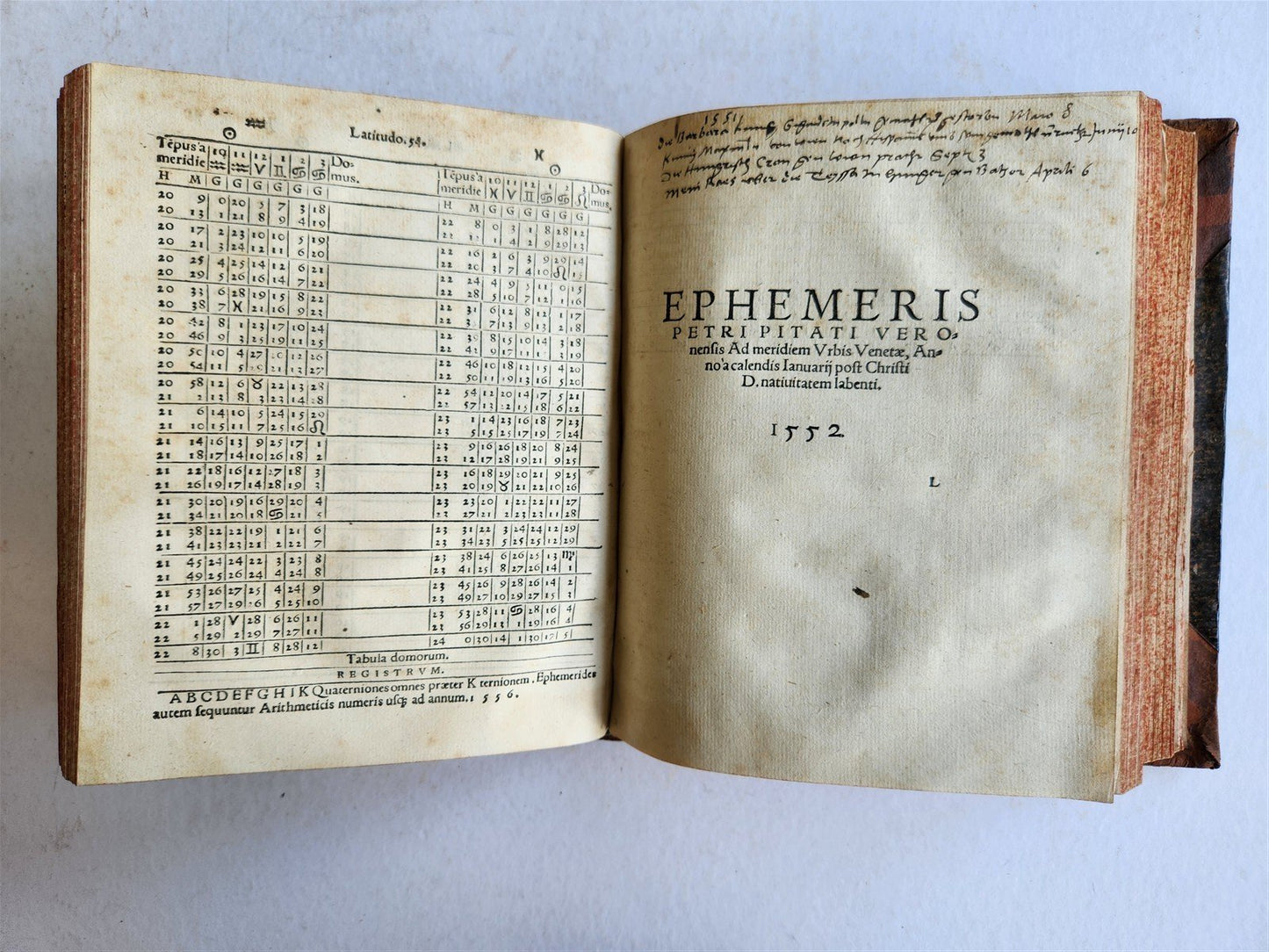
1553 Almanach Novum by Petrus Pitatus ANTIQUE astronomy astrology RARE
1553 Almanach Novum by Petrus Pitatus ANTIQUE astronomy astrology RARE
Regular price
$1,199.10 USD
Regular price
$1,713.00 USD
Sale price
$1,199.10 USD
Unit price
per
Couldn't load pickup availability
Petrus Pitatus [aka Pietro Pitati] (fl. circa 1550)
Almanach Novum ab Anno Scilicet 1552 ad Annum 1556 Computatum.
Tubingen: Per Ulricum Morhardum, 1553
Quarto, in this copy, the first signature including title page appear in duplicate in alternate settings;
woodcut printer's device to both title pages;
bound in later half calf with speckled paper boards, gilt-tooled ribbed spine
(binding worn, wormed; occasional faded water staining to contents, small paper repair to the margin of the first title);
some period marginal notes and underlining in chalky russet crayon;
rare, no copies in RBH;
Size 6 3/4 by 8 in.
Text in Latin
=================================
Pietro Pitati (in Latin, Petrus Pitatus) (?-fl. ca. 1550) was an Italian astronomer and mathematician. Bernardino Baldi, in his Cronica de matematici (1707) calls Pitati a noble Veronese who was trained in mathematics by a Benedictine friar named Innocentio da Novara.
It is known that he was the author of several astronomical works and almanacs. His Paschales atque nouiluniorum mensurni canones. De varia paschalis solemnitatis obseruatione...De Hebraica anni quantitate...Calendarium nouum cum noua aurei numeri positione, ortu quoque, & occasu stellarum fixarum (Venice, March 1537) is one of many sixteenth century attempts to reform the calendar, and establish, among other things, the correct day of Easter. This was his first work.
Pitati also wrote another book bearing on the length of the solar and lunar year, the fixed stars, and calendar reform, entitled: Compendium . . . super annua solaris atque lunaris anni quantitate Paschalis item solennitatis juxta veteres ecclesiae canones recognitione Romanique calendarii instauratione deque vero Passionis Dominicae die ortu quoque et occasu stellarum fixarum, in tres divisum Tractatus.[3] Pitati's proposal for calendar reform "pleaded for the rule whereby three out of four centennial years be ordinary (non leap-years). This is [now] the Gregorian rule."
Pitati compiled ephemerides, to which he added supplements over the years, such as Almanach nouum...Superadditis annis quinque supra ... Ephemeridas 1551. ad futurum Christi annum 1556. Isagogica in coelestem Astronomicam disciplinam ... Tractatus. tres perbreues de Electionibus, Reuolutionibus annorum, & mutatione aeris. Item horariae tabulae per altitudinem solis in die, ac stellarum in nocte ad medium sexti climatis.(Venice, 1542).
The lunar crater Pitatus is named after him. The mathematician and astronomer Giovanni Padovani was a student of Pitati.
===================================
Thank You
Refund Policy: We will issue a FULL REFUND, 100% money back if you are not satisfied with your purchase. Items must be returned to us within 20 days in order to receive a refund or replacement. Buyer is responsible for shipping costs.