Motka
1572 ORLANDO FURIOSO by LUDOVICO ARIOSTO amazingly illustrated ANTIQUE 16th CENT
1572 ORLANDO FURIOSO by LUDOVICO ARIOSTO amazingly illustrated ANTIQUE 16th CENT
Regular price
$1,399.30 USD
Regular price
$1,999.00 USD
Sale price
$1,399.30 USD
Unit price
per
Couldn't load pickup availability
Lodovico Ariosto
Orlando Furioso and Cinque Canti
Venice: Vincenzo Valgrisi; 1572
The famous work by Lodovico Ariosto.
Edited by Ieronimo Ruscelli.
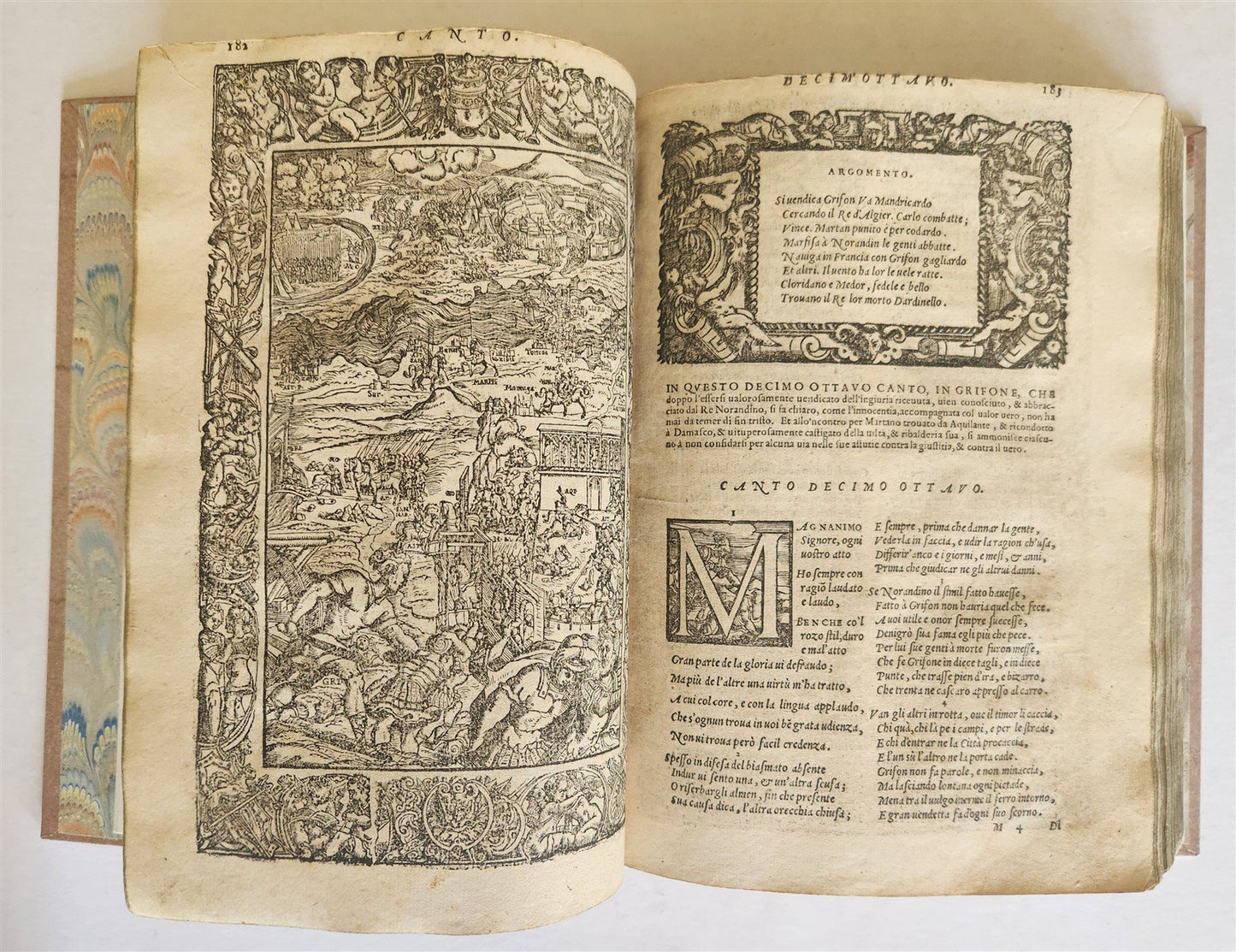
With figurative woodcut title border and woodcut decorations at beginning of each canto, as well as 51 full-page woodcuts (46 for Orlando Furioso and 5 for the "Cinque Canti".)
Dedication to Alfonso da Este, Life of Ariosto, Index of names of principle characters. (13 unnumbered pages)
Orlando Furioso and Cinque Canti, notes and commentary (654 numbered pages)
Index (32 unnumbered pages)
One of the earliest Valgrisi editions to include the "Cinque Canti" with the 5 extra woodcuts.
The 51 full page illustrations are usually attributed to the school of Dosso Dossi.
Recent rebound professionally with new endpapers.
General browning and foxing.
Title page somewhat trimmed in lower margin and with ownership entry from 1832.
Trimmed close on upper margin.
Size: 7 1/4 by 9 3/4 inches
Text in Italian
========================================
Orlando furioso (The Frenzy of Orlando) is an Italian epic poem by Ludovico Ariosto which has exerted a wide influence on later culture.
Orlando furioso is a continuation of Matteo Maria Boiardo's unfinished romance Orlando innamorato (Orlando in Love, published posthumously in 1495). In its historical setting and characters, it shares some features with the Old French La Chanson de Roland of the eleventh century, which tells of the death of Roland. The story is also a chivalric romance which stemmed from a tradition beginning in the late Middle Ages and continuing in popularity in the 16th century and well into the 17th.
Orlando is the Christian knight known in French (and subsequently English) as Roland. The story takes place against the background of the war between Charlemagne's Christian paladins and the Saracen army that has invaded Europe and is attempting to overthrow the Christian empire. The poem is about knights and ladies, war and love, and the romantic ideal of chivalry.
It mixes realism and fantasy, humor and tragedy.
The stage is the entire world, plus a trip to the Moon. The large cast of characters features Christians and Saracens, soldiers and sorcerers, and fantastic creatures including a gigantic sea monster called the Orc and a flying horse called the hippogriff. Many themes are interwoven in its complicated episodic structure, but the most important are the paladin Orlando's unrequited love for the pagan princess Angelica, which drives him mad; the love between the female Christian warrior Bradamante and the Saracen Ruggiero, who are supposed to be the ancestors of Ariosto's patrons, the House of Este of Ferrara; and the war between Christian and Infidel.
The poem is divided into forty-six cantos, each containing a variable number of eight-line stanzas in ottava rima (a rhyme scheme of abababcc). Ottava rima had been used in previous Italian romantic epics, including Luigi Pulci's Morgante and Boiardo's Orlando Innamorato.
Ariosto's work is 38,736 lines long in total, making it one of the longest poems in European literature.
=========================================
Thank You
Refund Policy: We will issue a FULL REFUND, 100% money back if you are not satisfied with your purchase. Items must be returned to us within 20 days in order to receive a refund or replacement. Buyer is responsible for shipping costs.