Motka
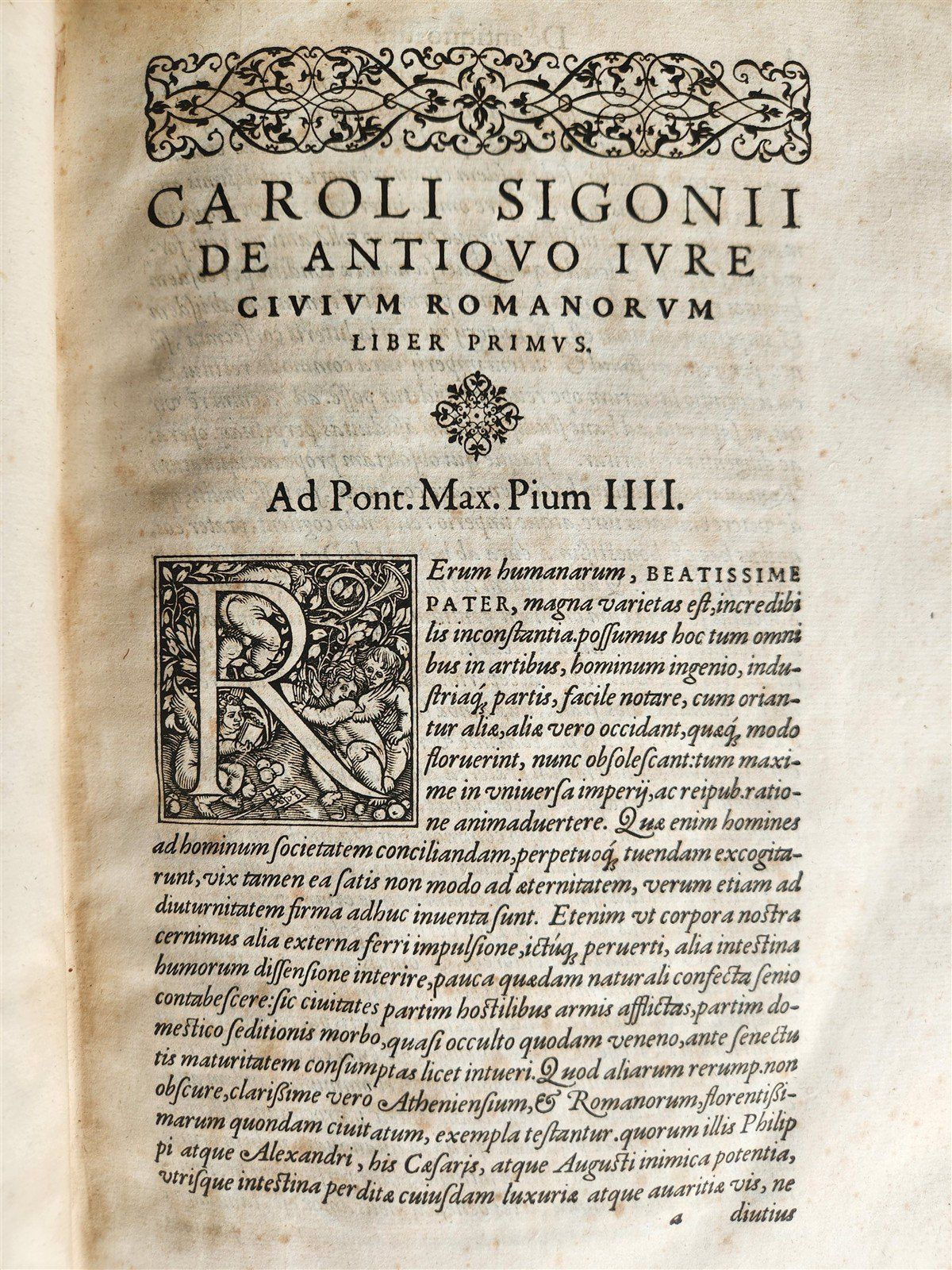
1576 HISTORY of ATHENS & SPARTA by Carlo SIGONIO antique 16th CENTURY FOLIO
1576 HISTORY of ATHENS & SPARTA by Carlo SIGONIO antique 16th CENTURY FOLIO
Regular price
$899.50 USD
Regular price
$1,285.00 USD
Sale price
$899.50 USD
Unit price
per
Couldn't load pickup availability
De antiquo iure populi Romani libri eleven.
De republica Atheniensium libri IIII. De Atheniensium Laceaemoniorumque temporibus liber I.
In eosdem rerum & verborum indices copiosi.
by Carlo SIGONIO ( Caroli Sigonii )
Lutetiae (Paris ): Apud Jacobum Du Puys; 1576
folio : 8.5 by 13"
(De republica Atheniensium and De Atheniensium et Lacedaemoniorum temporibus the first well-arranged account of the constitution, history, and chronology of Athens and Sparta, with which may be mentioned a similar work on the religious, political, and military system of the Jews (De republica hebreorum).
(20)-677-(35) pages, including 2 folding plates.
Original full calf, spine with 6 raised bands,
Covers decorated with large central gilt medallions, and a gilt fillet in the frame.
Good copy, fresh interior, complete with its 2 folding plates, binding worn, front cover is partially detached
Manuscript ex-libris scratched on title page.
Text in Latin
===============================
Carolus Sigonius (Carlo Sigonio or Sigone) (c. 1524 – 1584) was an Italian humanist, born in Modena.
Having studied Greek under the learned Franciscus Portus of Candia, he attended the philosophical schools of Bologna and Pavia. In 1545, he was elected professor of Greek in his native place in succession to Portus. In 1552, he was appointed to a professorship at Venice, which he exchanged for the chair of eloquence at Padua in 1560.
To this period of his life belongs a quarrel with Robortello, due to the publication by Sigonius of a treatise De nominibus Romanorum, in which he corrected several errors in a work of Robertelli on the same subject. The quarrel was patched up by the intervention of Cardinal Seripando (who purposely stopped on his way to the Council of Trent), but broke out again in 1562, when the two rivals found themselves colleagues at Padua. Sigonius, who was of a peaceful disposition, thereupon accepted (in 1563) a call to Bologna. He died in a country house purchased by him in the neighbourhood of Modena, in August 1584.
The last year of his life was embittered by another literary dispute.
In 1583, Sigonius edited a manuscript purported to be the long-sought Consolatio by Cicero, written as a distraction from his grief at the death of his daughter Tullia. Published in Venice, it was based on a book found by an obscure bookseller, named Vianelli. Sigonius declared that, if not genuine, it was at least worthy of Cicero; those who held the opposite view (Antonio Riccoboni, Justus Lipsius, and others) asserted that Sigonius himself had written it with the object of deceiving the learned world, a charge which he explicitly denied. The original manuscript was never produced.
The work is now universally regarded as a forgery, whoever may have been the author of it.
===============================
Please see my other auctions
Thank You
Refund Policy: We will issue a FULL REFUND, 100% money back if you are not satisfied with your purchase. Items must be returned to us within 20 days in order to receive a refund or replacement. Buyer is responsible for shipping costs.