Motka
1581 ASTROLOGY & ASTRONOMY Ephemerides Johannes Stadius ANTIQUE 2 PIGSKIN VOLS
1581 ASTROLOGY & ASTRONOMY Ephemerides Johannes Stadius ANTIQUE 2 PIGSKIN VOLS
Regular price
$1,998.50 USD
Regular price
$2,855.00 USD
Sale price
$1,998.50 USD
Unit price
per
Couldn't load pickup availability
Johannes Stadius (1527-1579)
Ephemerides Anno 1554 usque ad Annum 1606.
Cologne: Apud Haeredes Arnoldi Birckmanni, 1581.
One work bound as two quarto volumes;
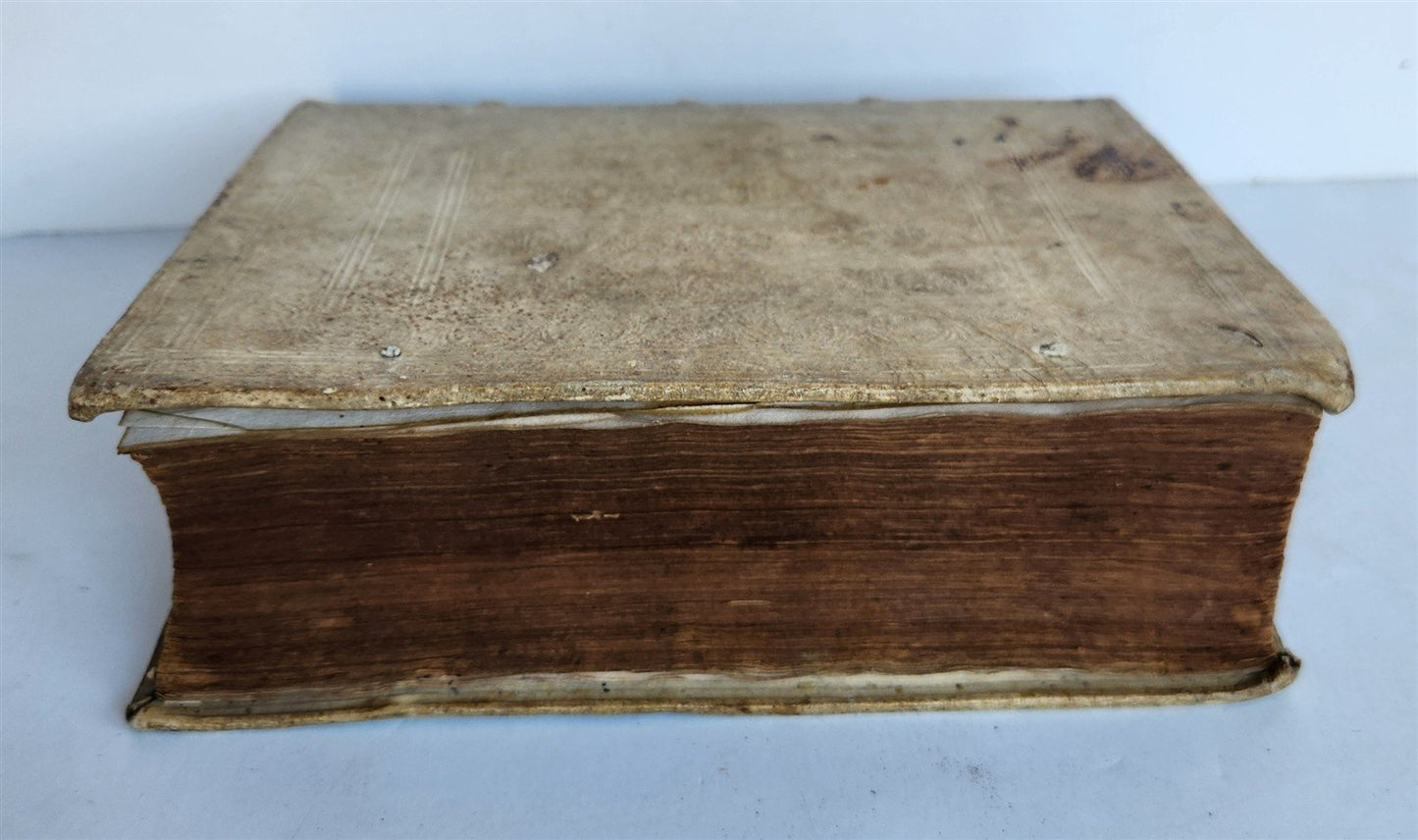
woodcut printer's device to title; the two volumes bound in full uniform original alum-tawed German pigskin over wooden boards,
lacking ties;
a few old library stamps at beginning and end of each volume
Very good condition, minor toning, some soiling to the pigskin
Size 6 by 7 3/4 in.
Text in Latin
Provenance:
Professor, Astronomer, Historian & Bibliophile Owen Gingerich, Smithsonian Astrophysical Observatory, Cambridge, MA
=======================
Johannes Stadius or Estadius (Dutch: Jan Van Ostaeyen; French: Jean Stade) ( 1527 – 1579), was a Flemish astronomer, astrologer, and mathematician. He was one of the important late 16th-century makers of ephemerides, which gave the positions of astronomical objects in the sky at a given time or times
During his stay in Brussels Stadius published his first work, the Ephemerides novae et auctae, first published by the publisher Arnold Birckmann of Cologne in 1554. An ephemeris (plural: ephemerides) (from the Greek word ephemeros, "daily") was, traditionally, a table providing the positions (given in a Cartesian coordinate system, or in right ascension and declination or, for astrologers, in longitude along the zodiacal ecliptic), of the Sun, the Moon, and the planets in the sky at a given moment in time; the astrological positions are usually given for either noon or midnight depending on the particular ephemeris that is used.
This work posited a link between mathematics and medicine and was influential on Tycho Brahe and Nostradamus.
Stadius had been encouraged to publish the Ephemerides by his old teacher Gemma Frisius.
Frisius had in a letter written in 1555 urged Stadius not to be afraid of being accused of believing in a moving earth and a stationary sun (i.e. the theory of Copernicus) or of abandoning the medieval Alfonsine Tables in favor of his own observations. In this letter Frisius further wrote that the system devised by Copernicus gave a better understanding of planetary distances, as well as of certain features of retrograde motion.
=========================