Motka
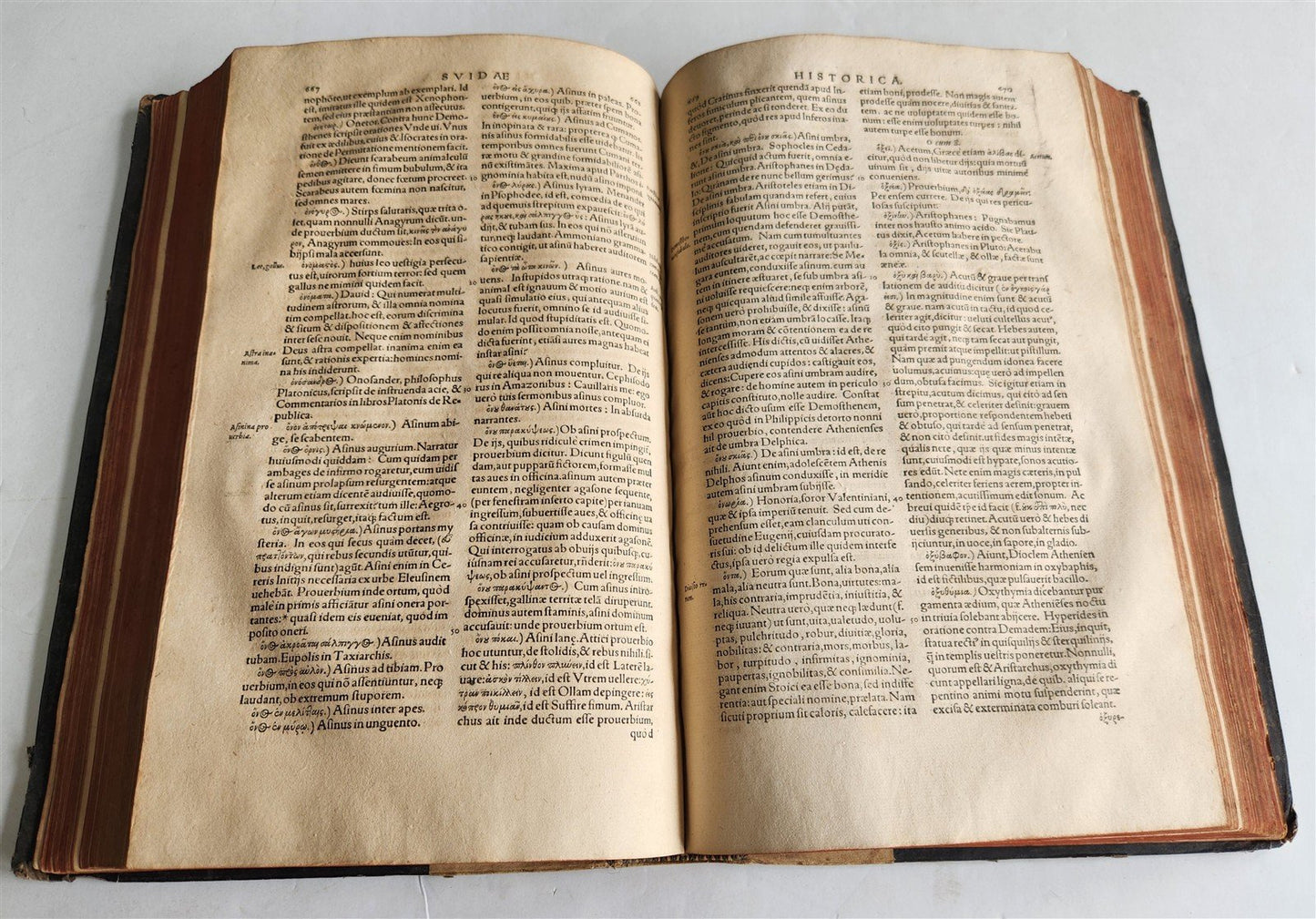
1581 Suidae Historica BYZANTINE ENCYCLOPEDIA LEXICON of ANCIENT WORLD antique
1581 Suidae Historica BYZANTINE ENCYCLOPEDIA LEXICON of ANCIENT WORLD antique
Regular price
$1,299.90 USD
Regular price
$1,857.00 USD
Sale price
$1,299.90 USD
Unit price
per
Couldn't load pickup availability
Suidae Historica, caeteraque omnia quae ulla ex parte ad cognitionem rerum spectant: opus iucunda rerum uarietate, & multiplici eruditione refertum: liberalitate magnif. & generosi uiri d. Caroli Villingeri, baronis à Schoeneberga: ... opera ac studio Hier. VVolfij annis abhinc 17, in Latinum sermonem conuersa: nunc uerò & emendata, & aucta. Accessit nunc demum rerum & uerborum extra ordinem alphabeticum memorabilium index, priore editione (multis sanè locis deprauata) propter publicam calamitatem, praetermissus. ..
by Soudas (Suda)
Basel, ex Officina Heerwagen per Eusebium Episcopium ; 1581.
With woodcut printer's mark at the title and repeated at the end.
7 pp., 2 leaves, 1056 columns, pp. 1057-1060, 16 leaves.
Original half hand tooled pigskin binding (damaged paper at the lower right corner of the front cover). Red edges.
Very good interior, some toning.
-Adams, p. 2065. Not in Soltesz (only other editions). First published in Venice in 1514. -
Third Basel edition (1544; 1564) of the famous word and subject lexicon, which is close to a modern conversational lexicon in a modern style.
Overall a good copy.
Lacks front endpaper
Small folio. Size 8 3/4 by 13 1/4"
Text in Latin
=====================
The Suda or Souda (Latin: Suidae Lexicon) is a large 10th-century Byzantine encyclopedia of the ancient Mediterranean world, formerly attributed to an author called Soudas or Souidas.
It is an encyclopedic lexicon, written in Greek, with 30,000 entries, many drawing from ancient sources that have since been lost, and often derived from medieval Christian compilers.
The Suda is somewhere between a grammatical dictionary and an encyclopedia in the modern sense.
It explains the source, derivation, and meaning of words according to the philology of its period, using such earlier authorities as Harpocration and Helladios.
It is a rich source of ancient and Byzantine history and life, although not every article is of equal quality, and it is an "uncritical" compilation.
Much of the work is probably interpolated, and passages that refer to Michael Psellos (c. 1017–1078) are deemed interpolations which were added in later copies.
This lexicon contains numerous biographical notices on political, ecclesiastical, and literary figures of the Byzantine Empire to the tenth century, those biographical entries being condensations from the works of Hesychius of Miletus, as the author himself avers.
Other sources were the encyclopedia of Constantine VII Porphyrogenitus (reigned 912–959) for the figures in ancient history, excerpts of John of Antioch (seventh century) for Roman history, the chronicle of Hamartolus (Georgios Monachos, 9th century) for the Byzantine age, the biographies of Diogenes Laërtius, and the works of Athenaeus and Philostratus. Other principal sources include a lexicon by "Eudemus," perhaps derived from the work On Rhetorical Language by Eudemus of Argos.
The lexicon copiously draws from scholia to the classics (Homer, Aristophanes, Thucydides, Sophocles, etc.), and for later writers, Polybius, Josephus, the Chronicon Paschale, George Syncellus, George Hamartolus, and so on.
The Suda quotes or paraphrases these sources at length. Since many of the originals are lost, the Suda serves as an invaluable repository of literary history, and this preservation of the "literary history" is more vital than the lexicographical compilation itself, by some estimation.
=======================
Please see my other auctions
Thank You
Refund Policy: We will issue a FULL REFUND, 100% money back if you are not satisfied with your purchase. Items must be returned to us within 20 days in order to receive a refund or replacement. Buyer is responsible for shipping costs.