Motka
1595 HISTORY of GREAT EMPIRES Babylonian Persian Greek Roman by SLEIDAN antique
1595 HISTORY of GREAT EMPIRES Babylonian Persian Greek Roman by SLEIDAN antique
Regular price
$449.40 USD
Regular price
$642.00 USD
Sale price
$449.40 USD
Unit price
per
Couldn't load pickup availability
Ioannes Sleidanus (Johannes Sleidan)
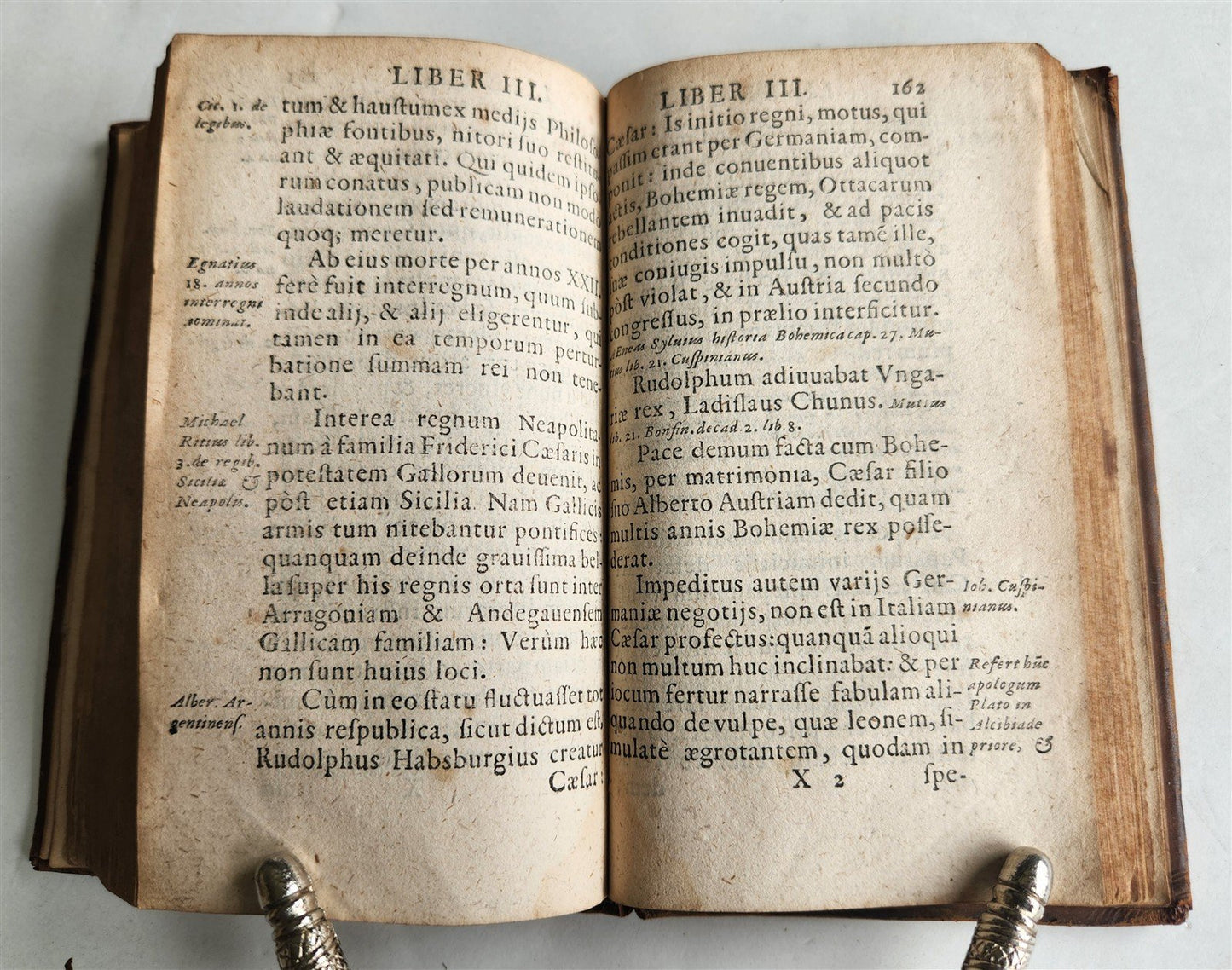
De Quatuor Summis Imperiis, Libri Tres
in gratiam iuventutis confecti... & studio Henrici Meibomii, Poëtae Caesarii..
Helmestadii (Helmstedt), Ex Officina typographica Iacobi Lucii; 1595
(15), 185, (23) lvs
Elegant edition of the late 16th century, of Johannes Sleidanus’s (1506-1556) masterwork of historiography, one of the most influential texts of the 16th century on universal history. The work traces, in a clear and didactic form, the history of the Four Great Empires (Babylonian, Persian, Greek and Roman), interpreted according to the prophetic scheme of Daniel, with a Protestant, typically humanist reformist perspective.
For more than two centuries it was a scholastic and university classic across Europe, used as a manual of universal history for training elites.
This 1595 edition, edited by the poet and historian Heinrich Meibomius (with notes, corrections and expanded indicses), represents one of the period’s most refined versions.
A fundamental work of Renaissance historiography and of the tradition of the “Four Empires.”
Rare edition, held in only a few public libraries; occasional appearances on the antiquarian market.
A complete copy
Full leather, spine with raised bands, worn
Good interior
Ex Libris/ancient annotations (including “Will. Fraser Writer to the Signet”).
Scottish lawyer, member of the Society of Writers to the Signet (the prestigious Edinburgh solicitors/notaries’ guild, which handled official documents with the royal seal).
A work of great appeal for collectors of books on history, the Protestant Reformation, Renaissance historiography and classical school texts.
Size 4 by 6 1/4"
Text in Latin
============================
Johannes Sleidanus or Sleidan (1506 – 1556) was a Luxembourgish historian and annalist of the Reformation.
He was born at Schleiden in the Duchy of Luxembourg, then part of the Habsburg Netherlands. He studied humanities at Leuven University and Cologne University, and law and jurisprudence at Paris and Orléans.
While among the Renaissance humanists of Leuven, he had adopted Protestant opinions, and entering the service of Cardinal du Bellay, was employed in the futile negotiations of the French court to make an alliance with the German Protestants against the Emperor Charles V. In 1542 he settled in Strasbourg.
Sleidanus had been accustomed to copy all papers bearing upon the Reformation to which he had access, and Martin Bucer, who had seen his collection, proposed to Philip of Hesse to appoint him historian of the Reformation, giving him a salary and access to all necessary documents. After some delay the heads of the league of Schmalkalden agreed to the proposal, and Sleidanus began his great work, finishing the first volume in 1545
In that year he was recalled to diplomacy, and went to England in a French embassy to Henry VIII. While there he collected materials for his history. On his return he represented Strasbourg at the diets of Frankfurt and Worms, and went on to Marburg to explore the archives of Philip of Hesse.
The war of the league of Schmalkalden interfered with this work, and also prevented the payment of Sleidanus, who in his difficulties applied to England for aid, and at Cranmer's intercession received a yearly pension from Edward VI, which, however, was never paid out.
In 1551 Sleidanus went to the Council of Trent as representative from Strasbourg, charged also with full powers to act for the imperial cities of Esslingen, Ravensburg, Reutlingen, Biberach and Lindau. Soon afterwards he became a civil servant of the city of Strasbourg, and finished his great task in 1554, though lack of money and other misfortunes compelled him to delay printing. Sleidanus died in poverty at Strasbourg in October 1556
The book appeared in the preceding year, Commentariorum de statu religionis et reipublicae, Carolo V. Caesare, libri XXVI.; it was translated into English by John Daus in 1560 and by G. Bohun in 1689. It was drafted with some care for impartiality, but this approach pleased no one, not even Melanchthon. It remains a valuable contemporary history of the times of the Reformation, and contains a large collection of documents.
==========================
Thank You
Refund Policy: We will issue a FULL REFUND, 100% money back if you are not satisfied with your purchase. Items must be returned to us within 20 days in order to receive a refund or replacement. Buyer is responsible for shipping costs.