Motka
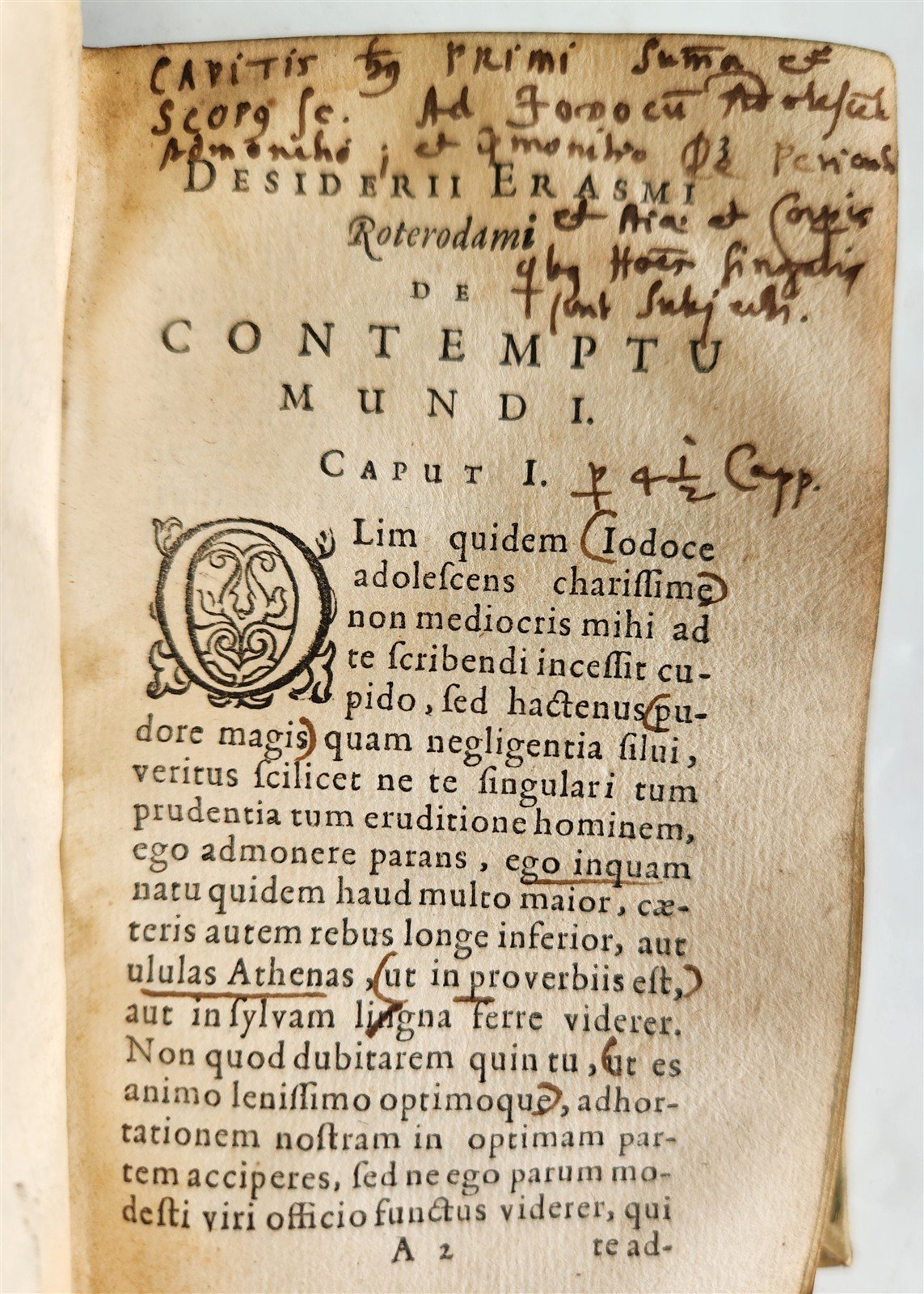
1641 WORKS by ERASMUS in LATIN pocket edition ANTIQUE vellum bound
1641 WORKS by ERASMUS in LATIN pocket edition ANTIQUE vellum bound
Regular price
$375.20 USD
Regular price
$536.00 USD
Sale price
$375.20 USD
Unit price
per
Couldn't load pickup availability
D. ERASMUS ROTTERDAMUS
Collection of 5 works.
Leiden, Maire; 1641-42
Contains:
- Querela pacis... 76 pp.
- De sarcienda ecclesiae concordia... 4 leaves, 175 pp.
- De contemptu mundi. 105 pp.
- De virtute amplectenda... 235 pp.
- De immensa dei misericordia. 143 pp.
Ex-Library copy.
Very good condition, some toning
Full vellum binding, manuscript title to the spine
Size: 3 by 5 1/4 inches
Text in Latin
==========================
Desiderius Erasmus Roterodamus (c.1466 – 1536), commonly known in English as Erasmus of Rotterdam or simply Erasmus, was a Dutch humanist, Christian theologian, and pioneering philologist and educationalist.
He was, through his writings and translations, one of the most influential scholars of the Northern Renaissance and a major figure of Western culture.
Erasmus was an important figure in Renaissance classical scholarship who wrote in a spontaneous, copious and correct but natural Latin style.
As a Catholic priest developing humanist techniques for working on texts, he prepared pioneering new Latin and Greek scholarly editions of the New Testament and of the Church Fathers, with annotations and commentary that were immediately and vitally influential in both the Protestant Reformation and the Catholic Reformation.
He also wrote On Free Will, The Praise of Folly, The Complaint of Peace, Handbook of a Christian Knight, On Civility in Children, Copia: Foundations of the Abundant Style and many other academic, popular and pedagogical works.
Erasmus lived against the backdrop of the growing European religious reformations. He developed a biblical humanistic theology in which he advocated the religious and civil necessity both of peaceable concord and of pastoral tolerance on matters of indifference. He remained a member of the Catholic Church all his life, remaining committed to reforming the church from within, but faced dangerous pushback from some university theologians. He promoted what he understood as the traditional doctrine of synergism, which some prominent reformers such as Martin Luther and John Calvin rejected in favour of the doctrine of monergism.
His influential middle-road approach disappointed, and even angered, partisans in both camps.
===========================
Thank You
Refund Policy: We will issue a FULL REFUND, 100% money back if you are not satisfied with your purchase. Items must be returned to us within 20 days in order to receive a refund or replacement. Buyer is responsible for shipping costs.