Motka
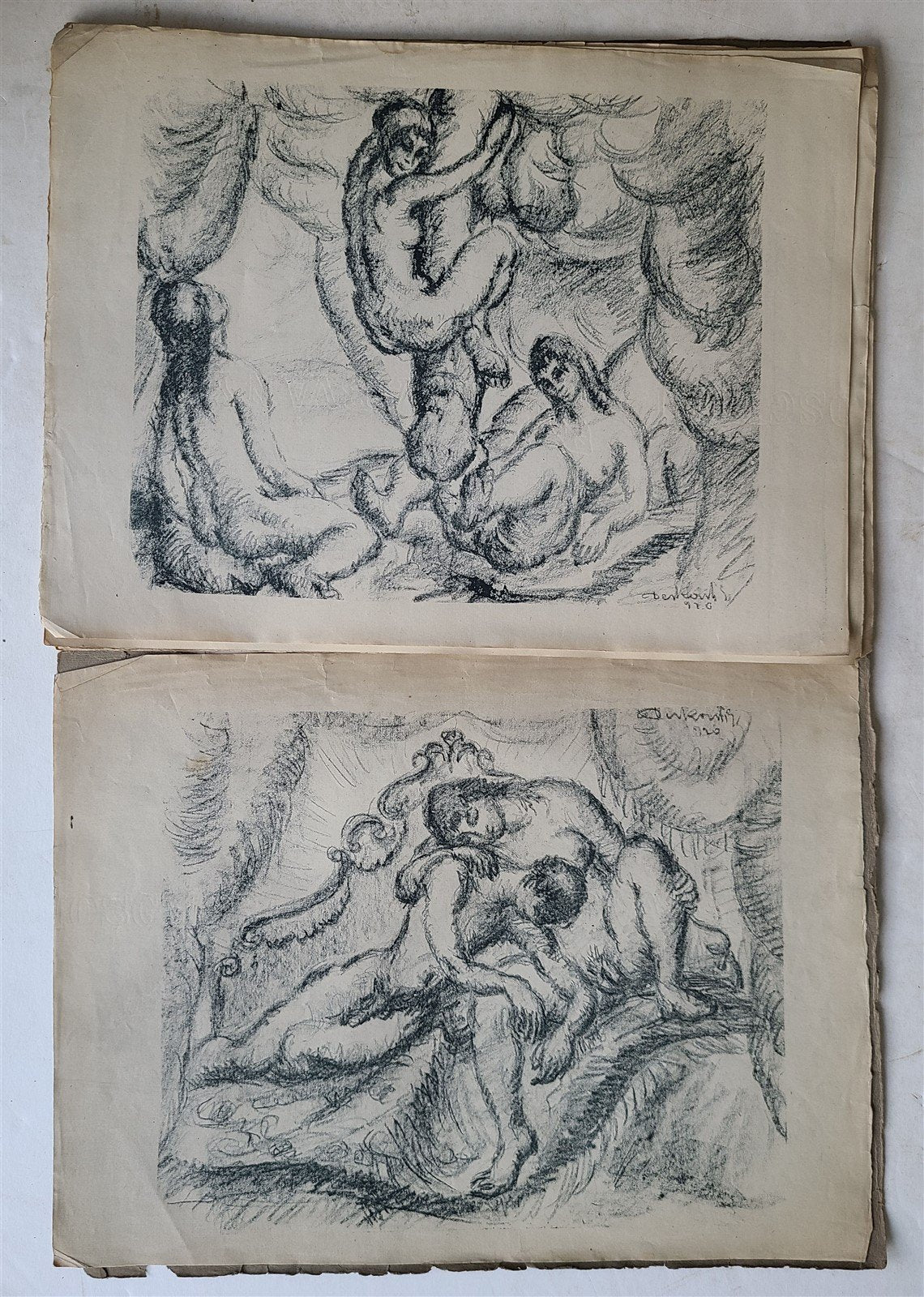
1924 PANDEMONIM SERIES OF 12 EROTIC LITHOGRAPHS by DERKOVITS antique SIGNED LTD
1924 PANDEMONIM SERIES OF 12 EROTIC LITHOGRAPHS by DERKOVITS antique SIGNED LTD
Regular price
$349.30 USD
Regular price
$499.00 USD
Sale price
$349.30 USD
Unit price
per
Couldn't load pickup availability
Pandemonium.
Lithographies originales.
by Gyula Derkovits
A.Cythere, n.d. [c1924]
Title page with and series of 12 leaves of original lithographs loose in a original paper folder (loose)
Complete
Limited edition: copy No. 131 of 300
current no. 131 of 300 copies (GA), signed by the artist
Jules (actually Gyula) Derkovits (1894-1934), Hungarian painter and graphic artist, was plagued by illness throughout his life.
He died poor and almost forgotten at the age of only 40 in Budapest.
Some wear at the edges.
Size 10.5 by 14.5"
=============================================
Gyula Derkovits (1894 - 1934, Budapest) was a Hungarian painter and graphic artist whose work shows elements of Expressionism, Cubism and Constructivism.
His father was a master carpenter and, despite showing some early artistic talent, he was forced to pursue the same trade. A friend who was a sign painter gave him his first drawing lessons, against his family's wishes.
Displeased with that situation, he fled from his family by volunteering to serve in World War I.
This proved to be an unfortunate decision, as he was wounded at the front, leaving him with a paralyzed left hand and a lung problem which became tuberculosis. In 1916, he moved to Budapest where he supported himself with a disability pension and, ironically, by doing some carpentry. In 1918, he joined the Hungarian Communist Party and remained a member until 1930, when membership became too dangerous.
During this time, he learned to draw and paint at various night schools until 1918, when Karoly Kernstok agreed to take him as a student, free of charge, at the Nyergesujfalu art colony and taught him copper engraving in addition to painting.
Unfortunately, the many changes in government disrupted pension payments and he was forced to return to manual labor, which was increasingly too difficult for him. As a result, he moved to Vienna in 1923, where he was able to find sufficient work doing paintings and etchings and had a successful exhibition at the Weihburg Gallery. He lived there for three years, then returned to Budapest.
In 1928, his reputation was secured by a series of twelve woodcuts depicting the peasant revolt of 1514 (led by Gyorgy Dozsa), despite having been done at the behest of the Communist Party. After 1930, his style became increasingly personal and eccentric. Tempera was his preferred medium then and his paintings, with subjects from daily life, became larger; almost monumental. He also worked in clay and wood sculpture. He died, aged only forty, after a series of illnesses.
================================
Please see my other auctions
Thank You
Pandemonium.
Lithographies originales.
by Gyula Derkovits
A.Cythere, n.d. [c1924]
Title page with and series of 12 leaves of original lithographs loose in a original paper folder (loose)
Complete
Limited edition: copy No. 131 of 300
current no. 131 of 300 copies (GA), signed by the artist
Jules (actually Gyula) Derkovits (1894-1934), Hungarian painter and graphic artist, was plagued by illness throughout his life.
He died poor and almost forgotten at the age of only 40 in Budapest.
Some wear at the edges.
Size 10.5 by 14.5"
Refund Policy: We will issue a FULL REFUND, 100% money back if you are not satisfied with your purchase. Items must be returned to us within 20 days in order to receive a refund or replacement. Buyer is responsible for shipping costs.